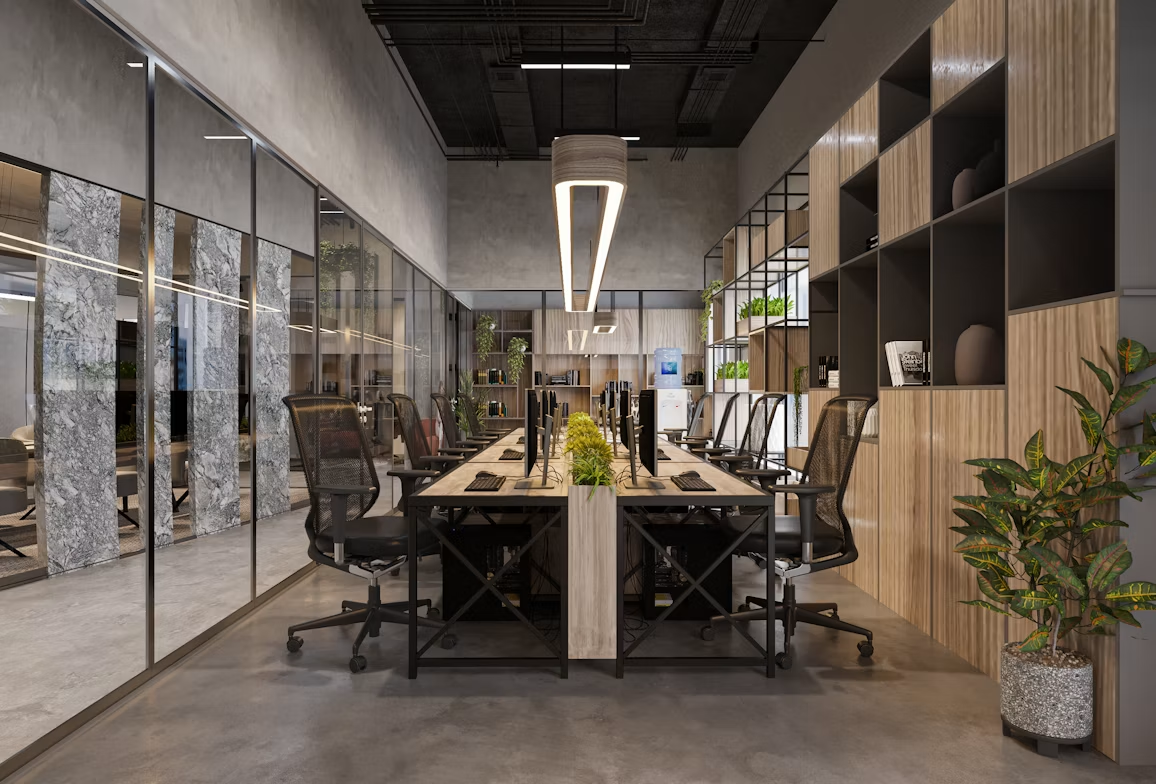
Interior Designer Website

Interior Designer Website: 7 Must-Have Tips to Convert Visitors into Paying Clients

Your interior designer website is your most important marketing asset. It works 24 hours a day, 7 days a week. It speaks to potential clients even when you are busy on a project site.

But here is the hard truth. Most interior designer websites look beautiful and convert terribly.

A stunning homepage with no clear call to action. A portfolio with no project descriptions. A contact page buried three clicks deep. Visitors arrive, browse briefly, and leave without ever reaching out.

That is lost revenue. Every single day.

In this guide, we share 7 must-have tips to turn your interior designer website into a client-generating machine. These are the exact principles our team at Device Doctor India applies when building websites for design professionals.

Why Your Website Is Your #1 Sales Tool

Before you read the tips, go over this information carefully. All your marketing activities are linked back to your website.

You can generate traffic to your profile from your Instagram posts that lead to your bio link. Clicks are sent from Google Ads to your landing page. Your SEO rankings attract organic traffic to your website. Your business cards contain links to your URL.

Every other marketing activity becomes sub-optimal unless your website is able to convert those visitors into enquiries. Come up with a solution to fix the website first. All that follows is a result of that. 

Tip 1: Make Your Value Clear in the First 5 Seconds

When a visitor lands on your interior designer website, they decide within seconds whether to stay or leave.

Your homepage hero section, the very first thing they see, must answer three questions instantly:

  • Who are you?
  • What do you do?
  • Where do you serve?

A headline like “Creating Stunning Living Spaces Across Mumbai” does this perfectly. It is specific, clear, and local. Compare that to vague headlines like “Design Is Our Passion,” which tell visitors absolutely nothing useful.

Below the headline, add a short subheading that mentions your specialisation. “Luxury residential and commercial interiors for discerning homeowners” tells clients exactly what level of service to expect.

We design homepage hero sections built around clarity and conversion. A clear first impression is the foundation of every high-performing interior designer website.

Alt Image

Tip 2: Build a Portfolio That Sells, Not Just Showcases

Most interior designer portfolios are image galleries. Beautiful to look at. Useless at converting.

A portfolio that actually generates leads does more than show pretty pictures. It tells a story. It answers the questions a potential client is silently asking.

Here is how to structure each portfolio project page:

Project Title and Location

"Modern 3BHK Interior Bandra, Mumbai" is far more useful than "Project 14." Location-specific titles also improve your local SEO rankings.

The Brief

What did the client want? What were the challenges or constraints? This context helps potential clients see themselves in the project.

Your Approach

Explain the design decisions you made. Why this colour palette? Why this furniture layout? This demonstrates your expertise and thinking process.

Before and After Photos

Nothing is more convincing than a transformation. Show the space before and after your work from matching angles.

Client Testimonial

End each project page with a short quote from the client. Social proof at the point of decision is incredibly powerful.

We build portfolio sections that rank on Google and convert visitors into enquiries simultaneously. Your best work becomes your best salesperson.

Tip 3: Place Contact CTAs Everywhere Not Just the Contact Page

This is one of the most common and costly mistakes on interior designer websites. The only place to contact the designer is the Contact page, which most visitors never reach.

A high-converting interior designer website has contact opportunities throughout every page:

  • A “Book a Free Consultation” button in the navigation header
  • A CTA section after every portfolio project
  • A floating WhatsApp button visible on every page
  • A contact form embedded on the homepage
  • A CTA banner between blog sections
  • A sticky call button on mobile

Make it effortless for interested visitors to reach you. The moment friction disappears, enquiry rates go up dramatically.

Every website we build at Device Doctor India includes strategic CTA placement on every key page. We track which CTAs convert best and optimise them continuously.

Alt Image

Tip 4: Optimise Your Website for Mobile Users

Over 70% of the internet traffic is mobile. If your ID web design is ugly and doesn’t function properly on a mobile device, you’re losing most of your prospective clients.

Mobile optimisation isn’t simply the process of getting the site to fit on a smaller screen. It means: 

  • Mobile users aren’t waiting: for long. If a website doesn’t load within 3 seconds, visitors will leave quickly. Optimize all images, use quick servers, and remove any unnecessary scripts.
  • Navigation Menus, buttons, and forms: should be easily tap-able with a thumb. Small buttons that are clustered together are confusing to mobile users and are likely to lead to higher bounce rates.
  • Mobile, a phone number should be tappable: with a Click-to-Call and/or WhatsApp buttons. The WhatsApp button is a great conversion for any interior design enquiry. Prominently add both to your mobile layout.
  • Readable Text without Zooming:  No one should be forced to pinch-zoom to see your text. Use at least 16pixels for all mobile design text. 

All interior designer websites are created with mobile-first design. Your website is responsive and looks and functions beautifully on any device, from smartphone to desktop. 

Alt Image

Tip 5: Add Social Proof That Builds Instant Trust

A potential client visiting your website for the first time does not know you. They are considering trusting you with one of the most personal spaces in their life, their home.

Social proof reduces that hesitation dramatically. Here is what to include:

  • Client Testimonials: Written testimonials on every key page. Video testimonials on the homepage for maximum impact. Real words from real clients carry more weight than anything you write about yourself.
  • Project Count and Experience: “50+ Projects Delivered” or “10 Years of Interior Design Experience” numbers build credibility instantly.
  • Media Features and Awards If your work has been featured in a magazine, blog, or design publication, display those logos prominently. Third-party recognition builds enormous trust.
  • Google Reviews Widget: Embed your live Google rating on your website. A 4.8-star rating with 40 reviews displayed on your homepage is more convincing than any marketing copy.

We integrate all forms of social proof into the websites we build for interior designers. Trust is built before a single conversation happens.

Tip 6: Create a Services Page That Educates and Converts

The majority of interior designer websites will feature a “Services” page, which includes 2 or 3 general categories. That is not enough.

There are two things a high-converting services page does. It informs prospective clients of exactly what it is that you are providing them. And it filters them for you in advance, so those who contact you are on your side.

Design your services page in this way: 

  • Individual Service Sections Each service (residential interior design, commercial interiors, modular kitchens, turnkey projects, etc.) have their own service section. A short description, key benefits, and a CTA should be included in each section.
  • Your process explains how you work from the initial consultation to the final handover. Clients who are well-informed about your process feel more confident in reaching out. Not knowing is a major obstacle to enquiry.
  • Pricing Guidance: You do not have to specify the exact prices. However, a wide range of “starting from” numbers decreases hesitation. If the client doesn’t know the cost, they either put off or never ask about it.
  • FAQs Per Service: Answer the most commonly asked questions clients might have related to each service. This helps to develop confidence and removes the need for “chatting” or “back and forth” before the first call. 

We create service pages to inform, reassure, and convert. Before you even speak on the phone, your website should be selling.

Tip 7: Invest in Website Speed and Technical Performance

A slow interior designer website destroys conversions and hurts your Google rankings simultaneously. It is a double penalty you cannot afford.

Google’s Core Web Vitals measure three key performance indicators:

  • Largest Contentful Paint (LCP):  How fast your main content loads. Should be under 2.5 seconds.
  • First Input Delay (FID):  How quickly your site responds to the first user interaction. Should be under 100 milliseconds.
  • Cumulative Layout Shift (CLS):  How stable your page layout is as it loads. Unexpected shifts frustrate users and signal poor technical quality to Google.

Interior design websites are particularly vulnerable to speed issues because of large, high-resolution project photos. The solution is smart image compression, lazy loading, and a fast hosting environment.

We conduct full technical performance audits for every website we build and optimise. A fast website ranks better, converts more visitors, and delivers a professional first impression.

Get a free website audit from our team — we will identify every technical issue that is costing you rankings and leads right now.

Alt Image

Your Website Should Work as Hard as You Do

You put enormous effort into every design project you take on. Your website should match that effort, working for you around the clock to attract, impress, and convert the right clients.

At Device Doctor India, we specialise in building high-performance websites for interior designers. From homepage strategy to portfolio design, service pages to technical SEO, we handle everything.

The result is a website that does not just look impressive. It generates enquiries consistently, month after month.

Contact us today for a FREE interior design lead generation consultation.

Blog & News From Us!

Our blogs keep you updated on the latest IT developments in web and mobile app development, digital marketing, AI & ML, blockchain, IoT, and cybersecurity through our regularly updated blog. Our team of experts is dedicated to providing valuable insights that will help you stay ahead of the curve in the fast-paced world of IT.

IB Management Module
App Development

IB Management Module: Why Your Forex CRM Needs One

For most retail forex brokerages, Introducing Brokers drive between 40 and 70 percent of new funded account acquisition. That is not a secondary growth channel. That is the primary one. IBs bring local market knowledge, established trust networks, and client relationships that no paid advertising campaign can replicate. In emerging

MT5 Full License
Forex Brokerage

How to Get an MT5 Full License from MetaQuotes: Complete Guide for New Brokers

The MetaTrader 5 platform powers over 1,000 brokers worldwide. It is the default platform choice for new forex brokerages. But getting access to MT5 as a broker is not as simple as signing up online. MetaQuotes, the company behind MetaTrader, maintains strict eligibility requirements. The application process is structured. Pricing

Best Payment Gateways for Forex
Forex Brokerage

Best Payment Gateways for Forex Brokers Accepting Global Clients

Forex is the largest financial market in the world. Daily trading volumes exceed $7.5 trillion. Yet processing payments for forex clients is one of the most operationally complex challenges a broker faces. Standard payment processors reject forex merchants. Chargebacks from losing traders push dispute ratios past acceptable limits. Cross-border transactions

Mobile App Backend Development
App Development

Mobile App Backend Development Best Practices: A Complete Guide for 2026

Behind a great mobile application is a great back end. The front end gives users their interaction, and the back end does everything else, such as user authentication, databases, APIs, notifications, security, and more. Your application is fast, secure, scalable, and reliable, regardless of whether you are developing an eCommerce

Frequently Asked Questions

If you're looking to attract potential clients to your interior design website, what elements should you put on it?

This is not a bad checklist to follow for designing a high-converting interior designer website: homepage with value statement, a story-driven portfolio with project details and testimonials, multiple contact CTAs on each page, a detailed services page, and quick mobile performance. Client quotes and Google reviews are also great examples of social proof, which can have a positive impact on inquiries.

What's the cost of making an in-house designer site in India?

Costs will depend on complexity, number of pages, and features required. A professional interior designer website cost is between ₹25,000 and ₹ 1,00,000 or even higher. The returns of investing in a well-designed, fast, and conversion-optimised site are far greater than those of investing in a basic template site.

Should an interior designer's website be SEO friendly?

Absolutely. Even a pretty site with no search engine optimization has minimal organic visitors. When people in your area start looking for interior designers, your website will get noticed on Google by utilizing SEO. We include on-page optimisation as part of all our websites to ensure your site is impressive and findable right from the start.

What can I do to speed up my inside designer web page?

Optimise all project images before uploading, use a fast and reliable host, enable caching in browsers, don’t use too many unnecessary plugins, and use lazy loading for images. These technical optimisations are all part of the suite of optimisations our team performs on every website project that we work on.

Interior Designers: Do you need to use a website builder or build a custom website?

If you’re just starting, it’s OK to use a website builder, such as Wix or Squarespace. They also come with several drawbacks, such as speed, SEO control, and customisation. You have total control, performance, improved SEO, and a custom-designed site reflecting your brand and style. 

Call Now Button