

SEO Blog
SEO Audit Checklist: What a Professional SEO Audit Company in India Should Deliver
Most Indian businesses receive an SEO audit that is not actually an audit. They pay an agency. Within 24 hours, a PDF arrives in their
Home » Industry » Hotel Lead Generation » Hotel Website Design

Did you know that over 80% of travellers research hotels online before making a booking decision? And of those, a significant majority judge a hotel’s credibility based on its website alone — before ever reading a single review.
Your hotel website is not just a digital brochure. It is your most powerful sales tool, your 24/7 front desk, and your best chance to convert a curious visitor into a confirmed, direct booking — without paying a single rupee in OTA commission.
Yet most hotel websites in India are silently losing bookings every day. Slow load times, confusing navigation, no mobile optimisation, missing trust signals — these are not minor issues. They are revenue leaks.
The good news? The right hotel website design fixes all of this. In this guide, we walk you through the 10 must-have features every hotel website needs to turn more visitors into guests — backed by data, built on experience, and tailored for the Indian hospitality market.
Let us get into it.
Speed is not a luxury in hotel website design — it is a necessity. Google data confirms that 53% of mobile users abandon a website that takes more than 3 seconds to load. For hotels, every second of delay translates directly into lost bookings.
Consider this: if your hotel website takes 6 seconds to load and you receive 1,000 visitors a month, you could be losing over 500 potential guests before they even see your rooms.
Fast-loading hotel websites benefit in two critical ways:

To achieve optimal speed, a well-designed hotel website should use compressed images without losing quality, leverage browser caching, use a Content Delivery Network (CDN), and be hosted on a reliable, high-performance server.
Every hotel website we build at Device Doctor India is speed-optimised from the ground up — because a fast website is not just good design, it is good business.
This is a fact that should alter the way you approach your hotel website: More than 65% of hotel searches in India are done on mobile devices. If your site isn’t “mobile-first” designed, you’re losing out on a huge portion of your potential guests before they even see your best rooms.
Mobile-first hotel website design refers to navigating, the images, the booking forms, and the calls to action, all being designed with the mobile user in mind before being scaled up to desktop. Not vice versa.
What a truly mobile-optimised hotel website looks like:
Google also has mobile-first indexing, which means that they will rank your website by its mobile version. Not having a good mobile experience doesn’t just cost you your guests, it costs you your search rankings as well.
Each hotel website is built mobile-first, so that your property not only looks great on all devices your guests use, but performs well.
No zooming required to tap the menus, buttons, and booking widgets.
With a single click, a guest is connected to your front desk, eliminating the friction in the enquiry process.
Content is readable from top to bottom without scrolling horizontally.
Compressed, next-gen image formats (WebP) load like a dream on slow data.
This is the single most important conversion feature on your hotel website. Without a direct booking engine, every visitor who wants to book has no choice but to leave your site and go to an OTA, taking your 15–25% commission with them.

A hotel direct booking engine embedded directly on your website changes everything:
The booking engine should be prominently placed — visible without scrolling on both desktop and mobile — and should never redirect guests to a third-party page that feels disconnected from your brand.
Visitors have their eyes closed during check-in. They look at your photos before they read your room descriptions, check your amenities, or view your rates. If those pictures are dark, blurry, or taken on a cell phone, they will go.
A well-designed hotel website is filled with a number of things that are overlooked, and one of them is high-quality visuals. They contain the following:
All visuals should be optimised for fast loading and tagged with SEO-friendly alt text to help your website rank in Google Image Search — an often-overlooked traffic source for hotels.
A beautifully designed hotel website that no one can find is a wasted investment. Search engine optimisation built into the structure of your website ensures that when potential guests search for hotels in your location, your property appears — organically, consistently, and for free.

Dedicated pages targeting keywords like “hotel in [city]”, “resort near [attraction]”, or “budget hotel [neighbourhood]” capture highly specific, high-intent search traffic.
H1, H2, and H3 tags are structured correctly so Google understands your page content and ranks it appropriately.
Every page has a unique, keyword-rich meta title and description that appears in search results and encourages clicks.
Hotel-specific structured data (LodgingBusiness schema) helps Google display your star rating, price range, and amenities directly in search results.
Connecting your room pages, blog posts, offer pages, and location guides keeps visitors engaged longer and helps Google crawl your site more effectively.
Our team at Device Doctor India builds hotel websites with SEO architecture baked in from day one — not added as an afterthought — because ranking well is non-negotiable for sustainable direct bookings.
Discover our Hotel SEO Services — from technical SEO to local search optimisation, we make sure your hotel is found by the right guests at the right moment.
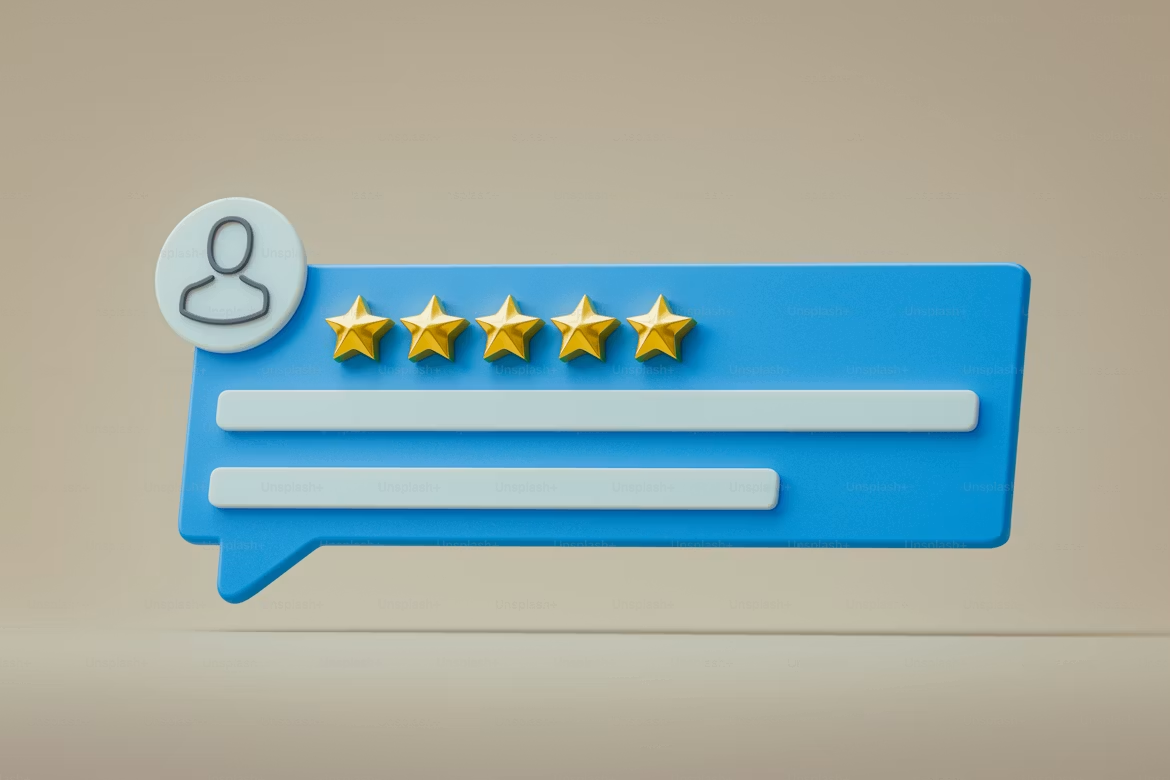
In the hospitality industry, trust is everything. A potential guest handing over their payment details to stay at your property is an act of faith — and your website needs to earn that faith before they click “Book Now.”
Trust signals are design and content elements that reassure visitors your hotel is legitimate, high-quality, and worth booking:
As a specialist hotel app development company, Device Doctor India builds custom Android and iOS hotel apps that integrate with your existing booking system, CRM, and payment gateway — delivering a seamless experience for guests and a powerful direct channel for your business.
Every page of your hotel website should have one job: move the visitor one step closer to a confirmed booking. And the tool that does that job is a well-written, well-placed Call to Action (CTA).
Strong, specific CTAs drive bookings. Here is what they look like in practice:
CTA buttons should be visually distinct, with a contrasting colour that stands out from the rest of the page — and should appear multiple times on long pages. The placement, wording, and design of CTAs alone can improve your hotel website’s conversion rate by 20–35%.
A guest who is ready to book but encounters an unfamiliar or insecure-looking payment page will abandon the booking. Payment security is not just a technical requirement — it is a conversion factor.
Your hotel website design must include:
The padlock icon in the browser address bar is the minimum baseline. A website without HTTPS is flagged as "Not Secure" by Google Chrome, instantly destroying trust.
UPI, Net Banking, credit and debit cards, and wallets like Paytm and PhonePe cover the full spectrum of how Indian guests prefer to pay.
Immediately after payment, an automated confirmation with booking details and check-in instructions dramatically reduces post-booking anxiety and cancellations.
Your payment gateway must meet global security standards for handling card data.
For properties that attract foreign tourists, Visa, Mastercard, and PayPal integration is essential.
We integrate secure, RBI-compliant payment gateways into every hotel website we build — ensuring guests can pay with confidence in whatever method they prefer.
India’s hospitality market is diverse — from domestic travellers across 28 states to international tourists from across the globe. A hotel website that speaks only one language and displays only one currency is leaving significant bookings on the table.
Multi-language and multi-currency support means:

At minimum, English and Hindi. Properties in tourist-heavy destinations should consider regional or international languages based on their guest demographics.

Allow international visitors to view room rates in their home currency (USD, EUR, GBP, AED) so they can make immediate booking decisions.

Beyond translation, culturally relevant messaging for different audience segments builds a connection that generic English copy cannot achieve.
This feature is particularly valuable for heritage hotels, resorts, and city hotels in destinations like Jaipur, Agra, Goa, Kerala, and Varanasi, where international guests form a significant share of bookings.
Sometimes a potential guest does not want to book immediately — they have a question. If they cannot get an answer quickly, they will close your tab and book somewhere else.
Live chat and WhatsApp integration solves this instantly:
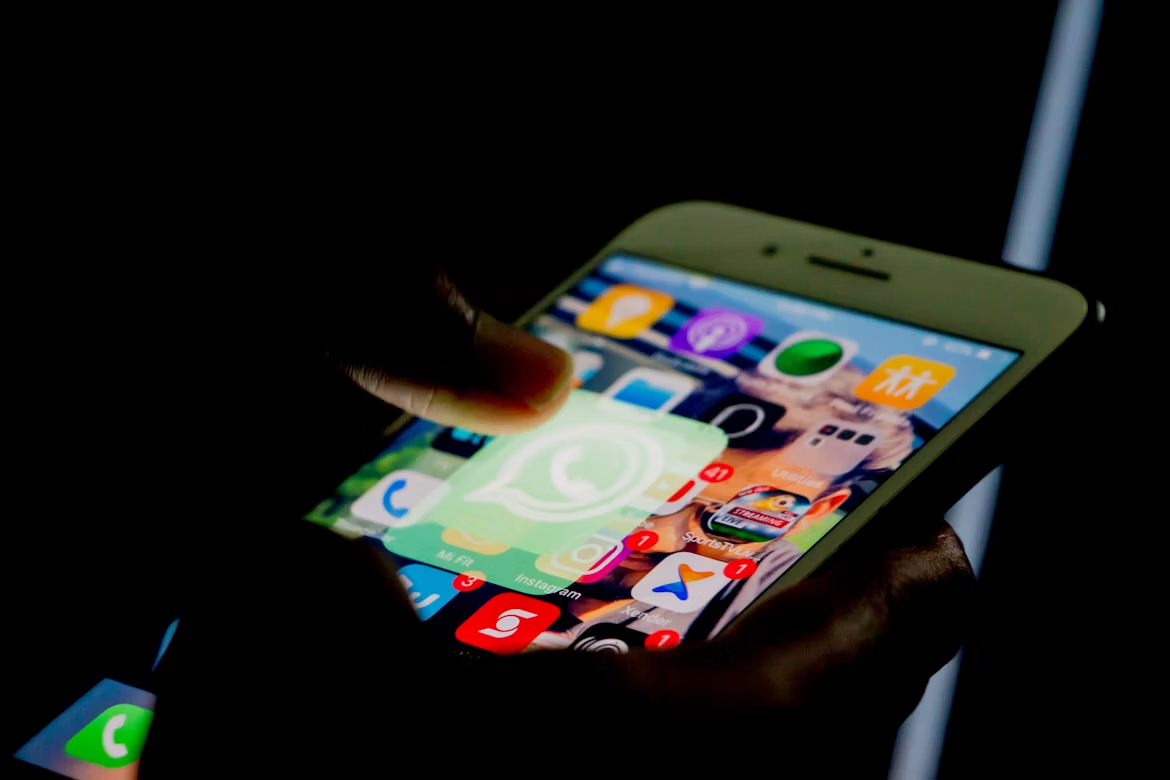
We integrate live chat and WhatsApp Business API into hotel websites as a standard feature — because in today’s hospitality market, being reachable in real time is not optional.
In the competitive Indian hospitality market, your hotel website is your most powerful, always-on sales tool. Every feature we have covered — from lightning-fast speed and mobile-first design to a seamless booking engine, trust signals, secure payments, and WhatsApp integration — works together to create a hotel website design that does not just look good but actively generates revenue.
The difference between a hotel website that fills rooms and one that loses bookings every day comes down to these 10 features. Audit your current website against this checklist, and you will find clear opportunities to improve your conversion rate, reduce OTA dependency, and build a stronger direct booking channel.
At Device Doctor India, we specialise in building hotel websites that check every box on this list — custom-designed, SEO-optimised, mobile-first, and conversion-focused. From web development and UI/UX design to SEO and digital marketing — we handle your complete digital presence under one roof.
Your property deserves a website that works as hard as you do. Let us build it together.
Our blogs keep you updated on the latest IT developments in web and mobile app development, digital marketing, AI & ML, blockchain, IoT, and cybersecurity through our regularly updated blog. Our team of experts is dedicated to providing valuable insights that will help you stay ahead of the curve in the fast-paced world of IT.
Most Indian businesses receive an SEO audit that is not actually an audit. They pay an agency. Within 24 hours, a PDF arrives in their

We’ve seen builders proudly show us a Facebook ads dashboard full of cheap leads, then admit almost none of them actually showed up for a

Here is something most home builders in India realise too late. Their website looks professionally done. It has photos of completed homes, a services list,

Most home builders we talk to don’t actually have a shortage of inquiries. They have a shortage of the right inquiries the ones that turn

If you are a home builder in India looking for local SEO for home builders, here is something worth knowing. When a family decides to

Before writing this, we looked at what’s already out there on “SEO for lawyers” — and almost every guide covers the same ground: practice area
A good hotel website design is fast, mobile-friendly, and built around a seamless direct booking engine. It combines high-quality visuals, clear CTAs, guest reviews, and SEO-optimised structure — all working together to turn visitors into confirmed bookings.
Hotel website design in India typically ranges from ₹25,000 for a basic site to ₹1,50,000+ for a fully custom, SEO-optimised website with a booking engine and payment gateway. At Device Doctor India, we offer tailored packages based on your property size and goals — contact us for a free quote.
Add a prominent booking engine, display a best-rate guarantee, run targeted Google and Meta ads, optimise your site for local SEO, and use email or WhatsApp campaigns to bring past guests back. These steps together can significantly reduce your OTA commission costs.
A hotel booking engine lets guests check availability, select rooms, and pay — all on your website without going to an OTA. Yes, every hotel website needs one. Without it, every interested visitor must book through a third party, costing you commission on every single reservation.
Absolutely. Over 65% of hotel searches in India happen on mobile, and Google ranks sites based on their mobile version first. A site that is not mobile-optimised loses both guests and search rankings — making mobile-first design a baseline requirement, not a bonus feature.


